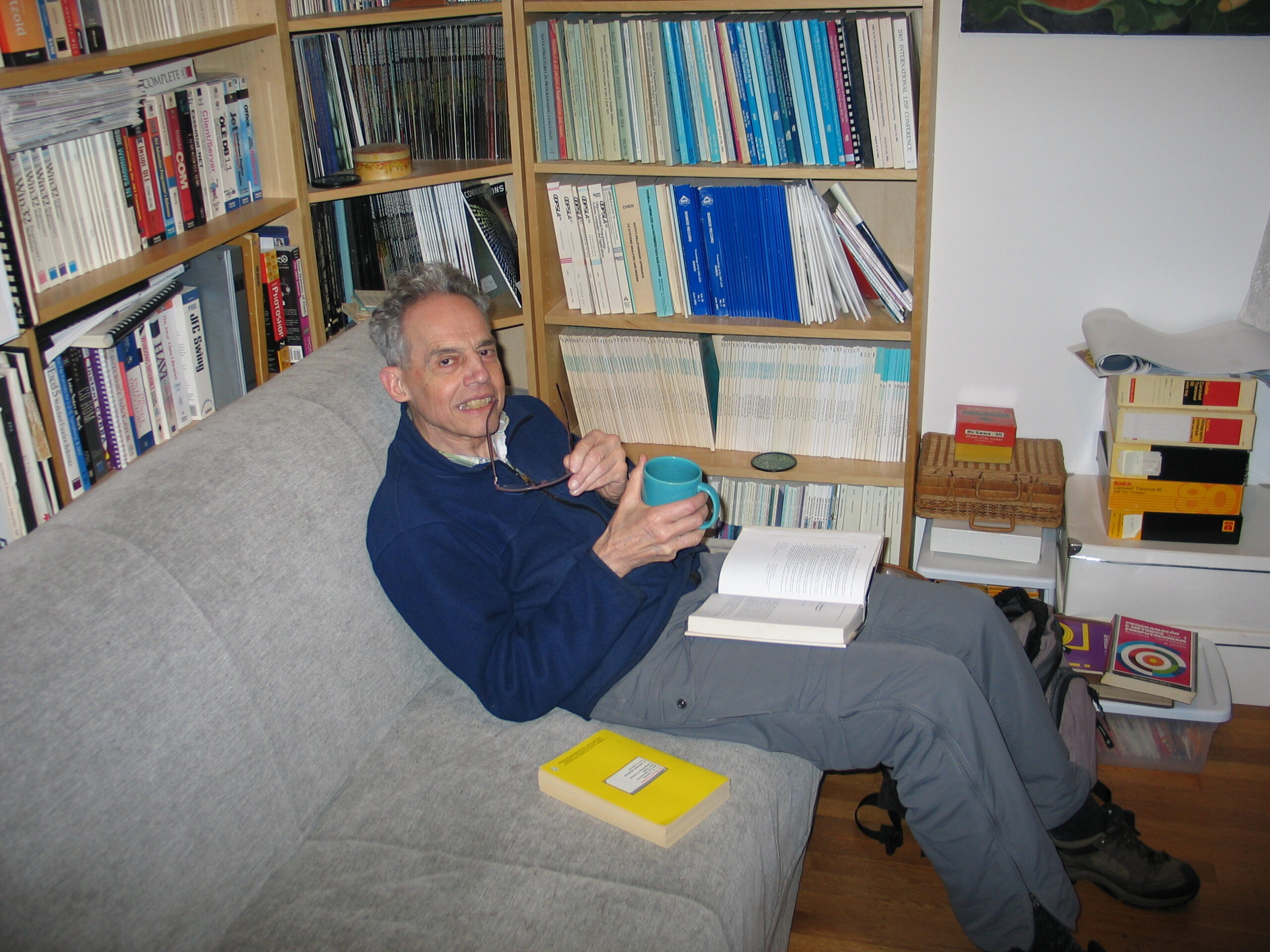
The field of economics began with theory (Adam Smith and The Wealth of Nations), later adding data and statistics. By the 1940s, people began exploring human behavior with simple games, which led to the important field of game theory. As computers became more widespread they began to be applied to economics. At UC Berkeley in the early 1960s, Frederick Balderston and Austin Hoggatt wrote an elaborate discrete event simulation of the lumber industry. As timesharing advanced, they envisaged computerizing the business simulation experiments up until then being run with written rules, paper forms, etc.
In the 1960s Hoggat and Balderston established the Management Science Laboratory at Berkeley’s Center for Research in Management Science: a 2800 square feet (260 square meters) space with reconfigurable partitions, teletypes, and closed-circuit video cameras and monitors. A combined PDP-5/PDP-8 minicomputer system ran the experimenter’s application system and logged timestamped responses. One of first experiments was a duopoly situation designed to see whether collaboration would take place even though the subjects were in isolated cubicles, interacting only via simulated market interactions.
By 1970, Hoggatt was ready to upgrade the computer system. APL had arrived in 1968 and Hoggatt felt it would combine experiment programming, data analysis, and publication. But APL wasn’t available on a sufficiently powerful, inexpensive computer at that time. Instead of asking NSF for a bigger computer, he proposed spending the money on building a one-off hardware/microcode/software system that could provide general timesharing as well as efficient APL processing.
The money was granted; between 1972 and 1976 the hardware was acquired and/or built, the microcode and software written, and experiments run. The system ran a few more years but was shut down because of high maintenance costs. Nevertheless it helped establish the field of computer-based behavioral research. Today software packages like z-Tree from Universität Zürich allow easy setup using networks of laptops.
“History of CRMS APL” [IEEE; unlocked] (Paul McJones, IEEE Annals, 2026 Jan-Mar) tells the story of CRMS and its APL upgrade from my point of view—as a person who wrote the APL microcode in 1972 and then left the project, only to take up research for this paper in 2024. The paper is based both on project materials I collected plus materials from the Bancroft Library at Berkeley. The materials I collected are available here: crms-apl.computerhistory.org.
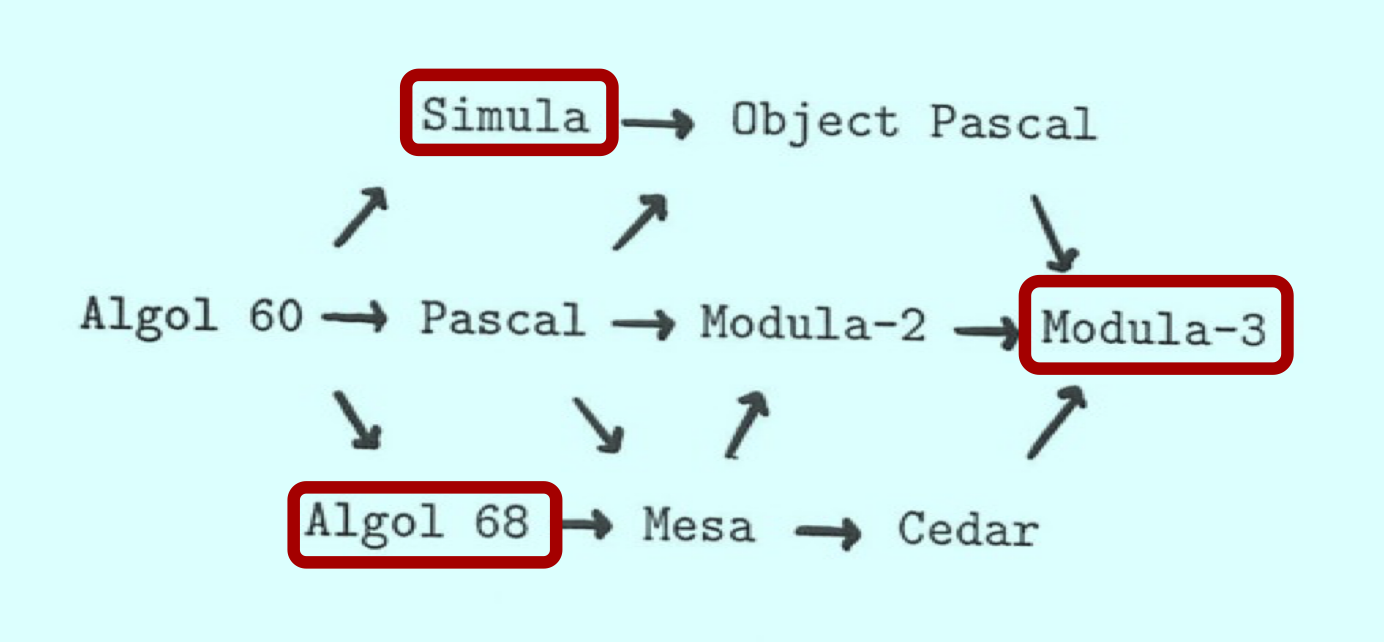
The diagram above, drawn by Nelson, gives an idea of its heritage. Mesa, designed at Xerox PARC in the mid 1970s, borrowed many ideas from Pascal, but added modules (with interfaces called DEFINITIONS modules and a module configuration language), exceptions, and threads (called processes, but they shared a single address space). Wirth spent a sabbatical at PARC, and decided to add definition modules to Modula-2. Meanwhile, PARC’s Cedar project extended Mesa with storage safety (via garbage collection) and runtime type determination. Then a core of PARC researchers followed their director Bob Taylor to establish the System Research Center (SRC) at DEC. They couldn’t take Cedar with them (it was proprietary, and ran only on exotic Dorado workstations). Another DEC lab had implemented a Modula-2 compiler, which the SRC people extended with their favorite Cedar Mesa features (exceptions, threads, garbage collection, and runtime type determination), naming the result Modula-2+. The nearby Olivetti Research Center, with other former PARC researchers, adopted this new language too. Seeing the utility of this language, Maurice Wilkes, retired from Cambridge but consulting at DEC and Olivetti, suggested to Wirth that Modula-2+ be revised and standardized as Modula-3. Wirth approved and the committee got to work, ultimately adding two important features, object types and generics; even still, the Modula-3 Report came in at just over 50 pages.
The SRC implementation at first generated C. Later the compiler was restructured with an interface making it fairly easy to substitute different code generators; one that used the back-end of gcc allowed widespread portability. Modula-3 adoption began spreading, facilitated by ftp to distribute source code and email and the comp.lang.modula3 newsgroup to share ideas and experience.
Researchers at SRC switched fairly quickly from Modula-2+ to Modula-3: the former was tied to older hardware, whereas Modula-3’s portability allowed it to run on the latest DEC ALPHA workstations. Projects included window system toolkits, algorithm animation, distributed systems, experimental programming languages, two-view and constraint-based editors, new web browsing paradigms, and program verification. Many of these projects produced libraries that became building blocks for subsequent projects. Researchers at several universities also found it a good base for ambitious projects, including an extensible operating system and an augmented reality system. One small company attempted to commercialize the language. An open-source developer used it to create the system used for many years to distribute FreeBSD source code.
Then Java came along, offering similar features plus “write once, run anywhere”—that plus Sun Microsystem’s marketing effort quickly eclipsed Modula-3. Even at SRC, researchers switched from Modula-3 to Java.
SRC’s system had always been open source, and there were several forks, including the commercial company’s proprietary version (which was later open-sourced). Gradually the forks were merged into two alternative releases, CM3 and PM3, which are both hosted at https://github.com/modula3/. CM3 will run on most modern platforms. Documentation exists, but isn’t always easy to navigate.
My personal interest in Modula-3 began when I worked at SRC and helped develop some of the standard library interfaces and an application. I hope the language will be remembered—and used—for many years to come.
Would this be of any interest to the Software Preservation Group?
I immediately agreed: Emacs has a long and honorable history with many implementations, and Lars is a skilled and prolific retro-computerist. By August of this year as I worked to rejuvenate the Software Preservation web site, I noticed that the Emacs page listed the major implementations of Emacs, but did not actually link to the content, whereas Lars’s github repository is filled with source code for a wide variety of implementations and a README that gives detailed provenance. After consulting with Lars, I revised the Software Preservation project to create a presentation layer detailing all the information in his GitHub repository. You can trace the history from the original version written in TECO macros, the Lisp Machine versions, TVmacs in the Architecture Machine Group, Multics Emacs, Prime Emacs, Montgomery Emacs, Gosling Emacs, Zimmerman Emacs, GNU Emacs (and its derivatives), Epsilon, and MicroEMACS.
If you think others should be included, you’ll have to convince Lars.
Twenty-two years ago the Computer History Museum established an advisory committee (with staff, trustees, and volunteers) to explore issues of identifying, collecting, preserving, and presenting software. The Museum had just moved into its present quarters; the main Revolution exhibit was still far in the future. But the previous year, Grady Booch had gotten the ball rolling with a mass email entitled “Preserving classic software products” asking for people’s “top ten list of classic software products.” The replies to that email and the ensuing discussion made it clear that software collection and preservation were worth doing and needed to begin immediately, before more pioneers died and more source code was lost or destroyed.
Monthly meetings of the Software Collection Committee began in November 2003, covering a wide range of topics. Should collection be proactive or reactive? What priorities should guide proactive collecting? (Grady’s compiled top-ten lists provided initial input.) How should software be cataloged? How should it be presented? An initial workshop in October 2003 mostly asked questions, but a follow-up in May 2006 showed off work from CHM and from other organizations and individuals.
While many discussions raged for months, restless folks began “pilot projects” to collect materials from the original IBM 704 FORTRAN project, Doug Engelbart’s NLS/Augment project, and the APL programming language. A web site was set up to present the results of these pilot projects and the monthly meetings. An email list with an archive allowed people who couldn’t attend the meetings to participate in many discussions.
As time passed, interest in software preservation expanded. The Museum opened its Revolution! exhibit in 2011 followed by Make Software: Change the World! in 2017. Its Software History Center centralized and expanded the software-related curatorial staff. Source code releases became a regular occurrence. Work also went on outside the Museum. Software Heritage, founded by INRIA, maintains a replicated repository and populates it by crawling the world’s open-source software “forges” such as GitHub.com.
At the same time, the committee (renamed Software Preservation Group) lost mindshare: The meetings wound down in 2007, and traffic on the email list tapered down to a standstill by 2017. However, encouraged by the success of my original FORTRAN project, I had continued with a series of projects including LISP and C++. After retiring in 2010 I took on larger projects on ALGOL, Prolog, SETL, and BCPL and smaller ones on GEDANKEN, Mesa, PAL, and Poplar, plus program verification systems AFFIRM and PIVOT. Along the way, a few other people found their way to the Software Preservation Group, and created projects: Interactive C Environments (Wendell R. Pepperdine), Emacs (Lars Brinkhoff), and FOCAL (Bruce Ray).
By 2025, the “Projects” section of the Software Preservation Group web site was still serving a useful purpose, but the overall web site was showing its age: the landing page suggested activities no longer in progress, the underlying Plone content management system hadn’t been updated in 20 years created a burden on the Museum’s IT group to keep running and backed-up, and the use of a different domain deemphasized the connection to the Museum. Discussions with David Brock and Hansen Hsu of the Museum’s Software History Center led to the idea of rebuilding the web site with static HTML on a subdomain of the Museum’s regular computerhistory.org.
As the author of most of the content, I took on this effort in July 2025. It was fairly easy to convert the project web pages I’d created, but I wasn’t sure what to do with projects created by others that had seen little or no activity for years and decades. I managed to contact the original authors, and worked with them to tidy things up (especially Emacs). I also tracked down materials from the 2003 workshop, almost all the meetings (agendas, minutes, and presentation handouts), and the email archive.
While waiting for word back from the NLS/Augment and APL projects, I couldn’t resist starting a brand-new project: the Modula-3 programming language. That will be the subject of another post.
In 2014, the Computer History Museum released the Xerox Alto file server archive, constituting about 15,000 files from the Xerox Alto personal computer including the Alto operating system; BCPL, Mesa, and (portions of the) Smalltalk programming environments; applications such as Bravo, Draw, and the Laurel email client; fonts and printing software (PARC had the first laser printers); and server software (including the IFS file server and the Grapevine distributed mail and name server). I told the story behind that archive here.
Today CHM released the Xerox PARC Interim File System (IFS) archive:
The archive contains nearly 150,000 unique files—around four gigabytes of information—and covers an astonishing landscape: programming languages; graphics; printing and typography; mathematics; networking; databases; file systems; electronic mail; servers; voice; artificial intelligence; hardware design; integrated circuit design tools and simulators; and additions to the Alto archive.
A blog post by David Brock introduces the archive. Access to the archive itself is available here.
I began working on this project in 2018 under an NDA with PARC: reading the old media prepared years earlier by Al Kossow, updating the conversion software I’d written for the earlier Alto project, and winnowing down a list of 300,000 files to the 150,000 files that I submitted to PARC management for approval. David Brock’s post ends with an Acknowledgments section noting all the people at CHM and PARC who contributed.
In 2023 computers are all around us: our phones, tablets, laptops, and desktops, and lurking inside our television sets, appliances, automobiles, to say nothing of our workplaces and the internet. It wasn’t always that way: I was born in 1949, just as the first stored-program digital computers were going into operation. Those computers were big, filling a room, and difficult to use. Initially a user would sign up for a block of time to test and run a program that had been written and punched into paper tape or 80-column cards.cThe fact that an expensive computer sat idle while the user was thinking or mounting tapes seemed wasteful, so people designed batch operating systems that would run programs one after the other, with a trained operator mounting tapes just before they were needed. The users submitted their card decks and waited in their offices until their programs had run and the listings had been printed. While this was more efficient, there was a demand for computers that operated in “real time”, interacting with people and other equipment. MIT’s Whirlwind, TX-0, and TX-2 and Wes Clark’s LINC are examples.
The ability to interact directly with a computer via a terminal (especially when a display was available) was compelling, and computers were becoming much faster, which led to the idea of timesharing: making the computer divide its attention among a set of users, each with a terminal. Ideally the computer would have enough memory and speed so each user would get good service. Early timesharing projects included CTSS at MIT, DTSS at Dartmouth, and Project Genie at Berkeley. By 1966, Berkeley (that is, the University of California at Berkeley) decided to replace its IBM batch system with a larger computer that would provide interactive (time-shared) service as well as batch computing. None of the large commercial computers came with a timesharing system, so Berkeley decided they would build their own. The story of that project—from conception, through funding, design, implementation, (brief) usage, to termination—is told here:
Paul McJones and Dave Redell. History of the CAL Timesharing System. IEEE Annals of the History of Computing, Vol. 45, No. 3 (July-September 2023). IEEE Xplore (Open access)
How did I come to write that paper? In the winter of 1968-1969 I was invited to join the timesharing project. At that time I had about 2 years of programming experience gained in classes and on-the-job experience during high school and college (Berkeley). That wasn’t much, but it included one good-sized project—a Snobol4 implementation with Charles Simonyi—so the team welcomed me to the project. For the next three years I helped build the CAL Timesharing System, performed some maintenance on the Snobol4 system, and finished my bachelor’s degree. In December 1971, CAL TSS development was canceled, and I graduated and moved on to the CRMS APL project elsewhere on campus.
Those three years were hectic but immensely enjoyable. The team was small, with under a dozen people, housed first in an old apartment on Channing Way and then in the brand-new Evans Hall. Lifelong friendships were formed. People often worked into the night, when the computer was available, and then trooped over to a nearby hamburger joint for a late meal. Exciting things were going on around us. There were protests, the Vietnam War, and the first moon landings. Rock music seemed fresh and exciting. I had met my future wife in 1968, and we were married in 1970.
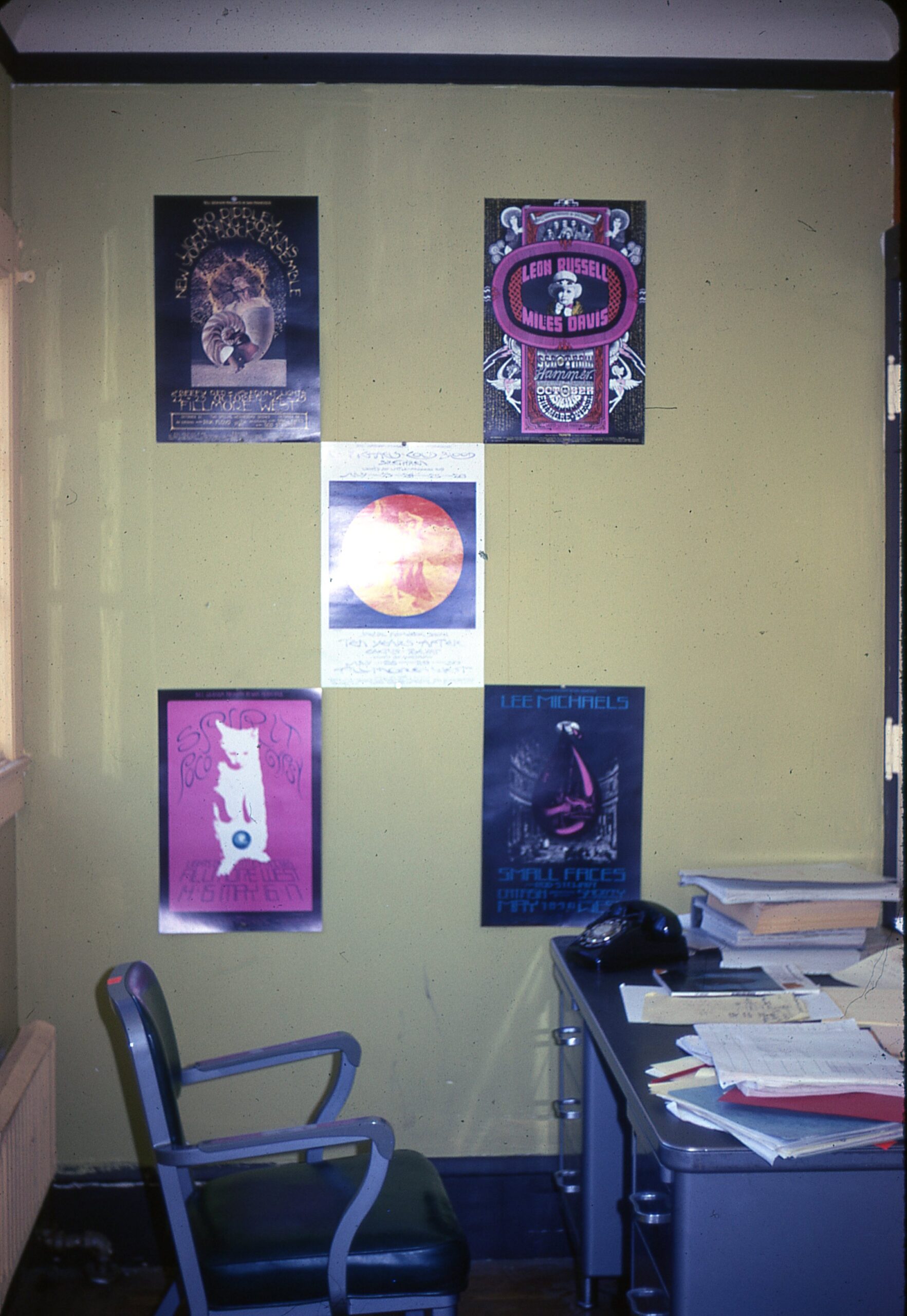
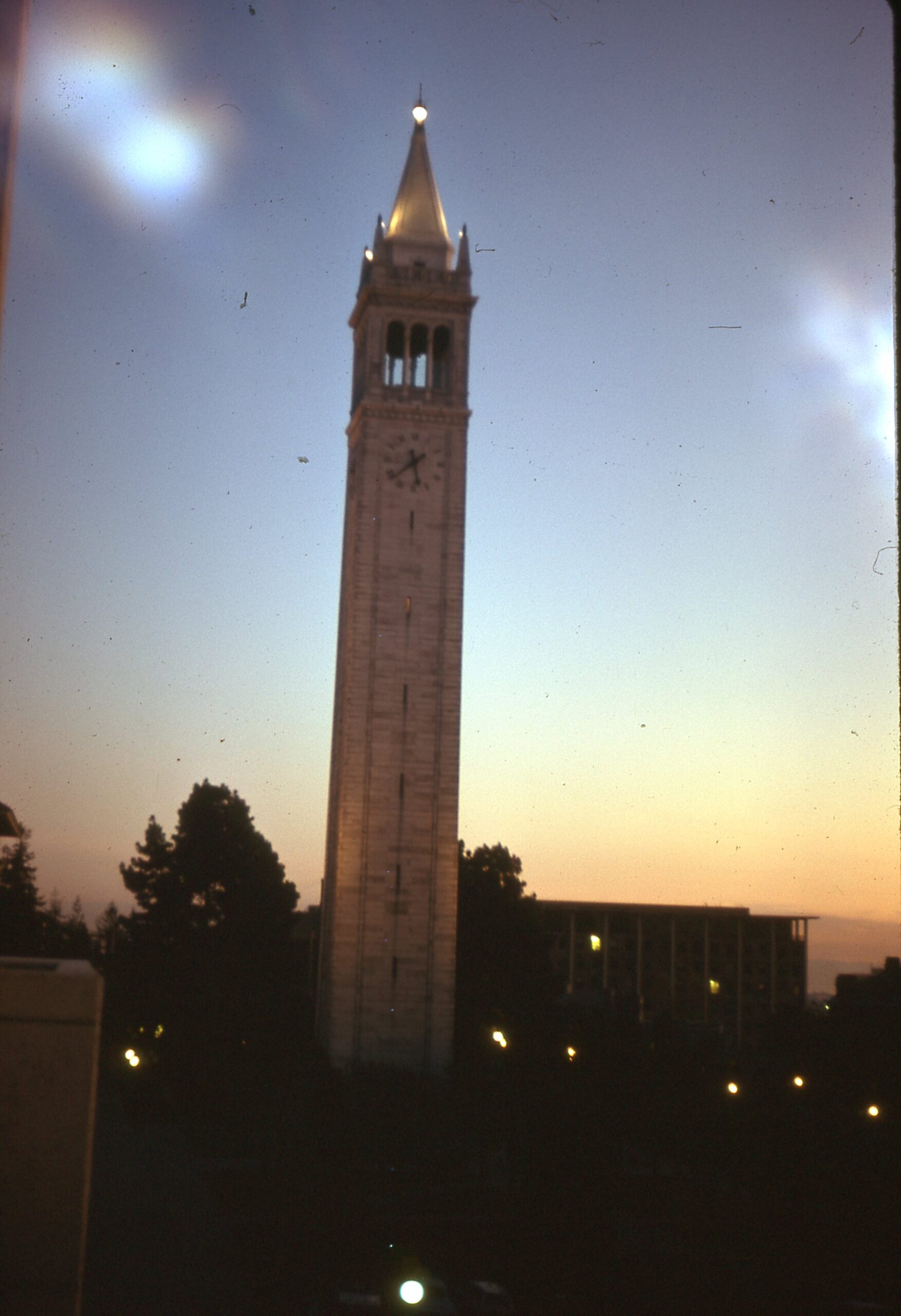
Rock posters in office on Channing WayMarching to the rallyNovember 1969: Antiwar Moratorium, in Golden Gate ParkView from brand-new Evans HallScenes from 1969-1971
As CAL TSS came to an end, we all agreed the experience could never be equalled. But we didn’t realize people in the future would be interested in studying our system, so we weren’t careful about preserving the magnetic tapes. However many of us kept manuals, design documents, and listings, plus a few tapes. In 1980 and again in 1991 we had reunions and I offered to store everything until it became clear what to do for the long run. Around 2003 I started scanning the materials and organizing a web site. In 2022 the Computer History Museum agreed to accept the physical artifacts, and this year they agreed to host the web site:
In April 2020, just as the Covid pandemic began, Annie Liu, a professor at Stony Brook University, emailed me to chat about programming language history. She suggested that Python, with its antecedents SETL, ABC, and C, would be a good topic for historical study and preservation. I mentioned that I’d considered SETL as an interesting topic back in the early 2000s, but unfortunately had not acted. After a few more rounds of email with her, I began looking around the web and Annie introduced me to several SETL people. Starting with these people, a few other personal contacts, and some persistence, I was soon in touch with much of the small but friendly SETL community, who very generously pored through their files and donated a wide variety of materials. The result is an historical archive of materials on the SETL programming language, including source code, documentation, and an extensive set of design notes that is available at the Software Preservation Group web site:
In addition, the digital artifacts and some of the physical artifacts are now part of the Computer History Museum’s permanent collection.
The SETL programming language was designed by Jack Schwartz at the Courant Institute of Mathematical Sciences at New York University. Schwartz was an accomplished mathematician who became interested in computer science during the 1960s. While working with John Cocke to learn and document a variety of compiler optimization algorithms, he got the idea of a high-level programming language able to describe such complex algorithms and data structures. [1] It occurred to him that set theory could be the basis for such a language since it was rich enough to serve as a foundation for all of mathematics. As his colleagues Martin Davis and Edward Schonberg described it in their biographical memoir to him: [2]
The central feature of the language is the use of sets and mappings over arbitrary domains, as well as the use of universally and existentially quantified expressions to describe predicates and iterations over composite structures. This set-theoretic core is embedded in a conventional imperative language with familiar control structures, subprograms, recursion, and global state in order to make the language widely accessible. Conservative for its time, it did not include higher-order functions. The final version of the language incorporated a backtracking mechanism (with success and fail primitives) as well as database operations. The popular scripting and general purpose programming language Python is understood to be a descendent of SETL, and its lineage is apparent in Python’s popularization of the use of mappings over arbitrary domains.
Schwartz viewed SETL first as a specification language allowing complex algorithms and data structures to be written down, conveyed to other humans, and executed as a part of algorithm development or even as a component of a complete prototype system. Actual production use would typically require reprogramming in terms of data structures closer to the machine such as arrays and lists. Schwartz believed that SETL programs could be optimized “by a combination of automatic and programmer-assisted procedures.” [3, page 70] He wrote several memos about his ideas for SETL [4, 5], and began assembling a project team — mostly graduate students. A series of design notes and memos called the SETL Newsletter was launched. [6] Malcolm Harrison, another NYU professor, had designed an extensible LISP-like language called BALM; in the first SETL Newsletter he sketched a simple prototype of SETL as a BALM extension. [7]
Over the following years the SETL Newsletters chronicled a long and confusing series of SETL implementations implemented with various versions of BALM and also with LITTLE, a low-level systems programming language.
BALMSETL (1971-1972) consisted of a runtime library of procedures corresponding to the various SETL operations, and a modification of BALM which replaced the standard BALM syntactic forms with calls to the appropriate procedures in the library. This runtime library used a hash-based representation of sets (earlier prototypes had used lists).
SETLB (spring 1972) consisted of a preprocessor (written in Fortran) that translated a simplified subset of SETL to BALMSETL. BALM was converted from producing interpretative code for a generalized BALM machine to producing CDC 6600 machine code.
SETLB.2 (1973?) was based upon a version of the BALM interpreter written in LITTLE, plus the SETL Run Time Library. It offered a limited capability for variation of the semantics of subroutine and function invocation by the SETLB programmer.
SETLA (1974?)’s input language was closer to SETL, but it still used the BALMSETL-based runtime library and BALM-based name scoping.
SETLC (1975?) consisted of a lexical scanner and syntactic analyzer (written in LITTLE), tree-walking routines (written in BALM) that built BALM parse trees), a translator that emitted LITTLE from the parse trees (written in BALM), and the LITTLE compiler. The generated LITTLE code used the SETL Run Time Library.
SETL/LITTLE (1977-1978?) consisted of a SETL-to-LITTLE translator, a runtime library, and a LITTLE-to-CDC 6600 machine code compiler (all written in LITTLE).
The final system (the only one for which source code is available) was ported to the IBM System/370, Amdahl UTS, DECsystem-10, and DEC VAX. There was also a sophisticated optimizer, itself written in SETL, which however was too large and slow to use in production. Work stopped around the end of 1984 as Schwartz’s focus moved to other fields such as parallel computing and robotics and many of the graduate students received their degrees. A follow-on SETL2 project produced more SETL Newsletters but no system.
Other SETL implementations
Starting in the mid 1970s, SETL-influenced languages were implemented at other institutions including Akademgorodok in Novosibirsk, and then at NYU itself. After a 30-year gestation period, GNU SETL was released in 2022. See https://www.softwarepreservation.org/projects/SETL/#Dialects for more.
Aftermath
Many reports and theses were written and papers were published. Perhaps the most well-known result was the NYUAda project, which was an “executable specification” for Ada that was the first validated Ada implementation. The project members went on to found AdaCore and GNAT Ada compiler.
[1] John Cocke and Jacob T. Schwartz. Programming Languages and Their Compilers. Preliminary Notes. 1968-1969; second revised version, Apri1 1970. Courant Institute of Mathematical Sciences, New York University. PDF at software preservation.org
[2] Martin Davis and Edmond Schonberg. Jacob Theodore Schwartz 1930-2009: A Biographical Memoir. National Academy of Science, 2011. PDF at nasonline.org
[3] Jacob T. Schwartz. On Programming: An Interim Report on the SETL Project. Installment 1: Generalities; Installment 2: The SETL Language, and Examples of Its Use. Computer Science Department, Courant Institute of Mathematical Sciences, New York University, 1973; revised June 1975. PDF at softwarepreservation.org
[4] Jacob T. Schwartz. Set theory as a language for program specification and programming. Courant Institute of Mathematical Sciences, September 1970, 97 pages.
[5] Jacob T. Schwartz. Abstract algorithms and a set theoretic language for their expression. Computer Science Department, Courant Institute of Mathematical Sciences, New York University. Preliminary draft, first part. 1970-1971, 16+289 pages. PDF at softwarepreservation.org
Maarten van Emden died on January 4, 2023, at the age of 85.[1] He was a pioneer of logic programming, a field he explored for much of his career. I was not in his field, and only got to know him starting in 2010, so this is a personal, but not professional, remembrance of a very dear friend.
Maarten van Emden, 26 February 2011
His life
Maarten was born in Velp, the Netherlands, but his family soon moved to the Dutch East Indies, where his botanist father was working on improving tea plants. In 1942 the Japanese invaded. Maarten’s father escaped to join the resistance, but Maarten, his younger sister, and his mother were sent to a detention camp. As the war came to a close, his father was able to rescue and reunite the family. Over the next few years they returned to the Netherlands, with a brief return to the newly-formed Indonesia, followed by boarding school in Australia for Maarten. They were finally reunited in the Netherlands in 1954, where Maarten began his final year of high school. After graduating in 1955, he went to national flight school (Rijksluchtvaartschool). He did a year of military service, including flight training, and then joined KLM Royal Dutch Airlines. But KLM was adopting DC-8 jets for transatlantic service, whose speed, capacity, and ease of operation led to the need for fewer pilots. Maarten took advantage of a company program to enroll part-time in an engineering curriculum at the University of Delft. Later he was laid off by KLM and finished a master’s degree as a full-time student. He then enrolled in the PhD program administered by the University of Amsterdam with research at the Mathematisch Centrum (now CWI), and also made several visits to the University of Edinburgh. His 1971 dissertation was An Analysis of Complexity and his advisor was Adriaan van Wijngaarden. Maarten was awarded a post-doctoral fellowship by IBM, which he spent at the Thomas J. Watson Research Center in Yorktown Heights, NY during the 1971-1972 academic year, before returning to Edinburgh for a research position under Donald Michie in the Department of Machine Intelligence. In 1975 he accepted a professorship at the University of Waterloo, and in 1987 he moved to the University of Victoria.
Programming
Maarten was one of 15 individuals recognized as Founders of Logic Programming by the Association for Logic Programming.[2] His work began with an early collaboration with Bob Kowalski[3] and continued throughout his career with collaborations and individual projects to explore many aspects of the field. Underlying his interest in logic programming was a fascination with programming and programming languages of all sorts.[4] His first language was Algol 60, which he taught himself using McCracken’s new book[5] when his university suddenly switched from Marchant calculators to a Telefunken TR-4 computer for the numerical methods course.[6] Moving on to the MC he was surrounded by ALGOL experts (his advisor van Wijngaarden was a member of the ALGOL 60 Committee and the instigator of the infamous ALGOL 68). Maarten was originally attracted to Edinburgh after hearing about the POP-2 timesharing system of Burstall and Popplestone; it was only later that he realized he’d initially used POP-2 as if it was ALGOL rather than a rich functional programming language. During his post-doc at IBM he learned APL and Lisp. Fred Blair was implementing a statically-scoped Lisp for the SCRATCHPAD computer algebra group.[7] And William Burge, who had worked with Burstall and Landin, was spreading the gospel of functional programming.[8] Ensconced in Edinburgh in 1972, he became an early convert to Kowalski’s logic programming, which he noted could be traced back as early as Cordell Green’s paper at the 4th Machine Intelligence workshop.[9] But Maarten’s first impression of Preliminary Prolog was not positive — the frequent control annotations seemed to detract from the logic. Nevertheless, he and Kowalksi began writing short programs to explore the ideas. And when David Warren returned from a visit to Marseille with a box of cards containing Final Prolog as well as his short but powerful WARPLAN program, things changed. The language no longer needed the control annotations, and Warren quickly ported its Fortran-coded lowest layer to the local DEC-10. WARPLAN served as a tutorial for all sorts of programs in the new language. Maarten was surprised that his friend Alan Robinson, the inventor of resolution logic, wouldn’t give up Lisp for logic programming.[10] At Waterloo, he advised Grant Roberts, who built Waterloo Prolog for the IBM System /370, and another series of students who built several Prologs for Unix. At Victoria, he wrote a first-year textbook for science and engineering students based on C:
It is indeed true that object-oriented programming represents a great advance. It is also true that polymorphism in object-oriented programming does away with many if-statements and switch statements; that iterators replace or simplify many loops. But experience has shown that introducing objects first does not lead to a first course that produces better programmers; on the contrary. It is as much necessary as in the old days to make sure that students master variables, functions, branches, loops, arrays, and structures.
I had the good fortune to grow up in three distinctive programming cultures: the Mathematical Centre in Amsterdam, the Lisp group in the IBM T.J. Watson Research Center, and the Department of Machine Intelligence in the University of Edinburgh. Though all of these entities have ceased to exist, I trust I am not the only surviving beneficiary.
If this book is better than others, it is due to my choice of those who were, often without knowing it, my teachers: H. Abelson, J. Bentley, W. Burge, R. Burstall, M. Cheng, A. Colmerauer, T. Dekker, E. Dijkstra, D. Gries, C. Hoare, D. Hoffman, N. Horspool, B. Kernighan, D. Knuth, R. O’Keefe, P. Plauger, R. Popplestone, F. Roberts, G. Sussman, A. van Wijngaarden, N. Wirth.
As different as we were, Maarten and I had a few things in common: fathers who piloted B-24 bombers in WWII, a charismatic mutual friend named Jim Gray, attendance at the 1973 NATO Summer School on Structured Programming, books named Elements of Programming, and a fascination with the early development of programming languages. Jim Gray had been an informal mentor for me at UC Berkeley as I worked on CAL Snobol and Cal TSS. Then he left Berkeley for IBM Research in Yorktown, and made friends with Maarten. Jim soon decided he couldn’t tolerate life on the east coast, but before leaving he encouraged Maarten and his wife Jos to drive across the country and visit him in California, where he would show them around. They took him up on the offer, and during a brief stay in fall 1972 at Jim’s home in Berkeley I met Maarten, but didn’t make much of an impression on him (although he later told me Jim had mentioned the “great programmers on Cal TSS”). The next summer both Maarten and I attended the NATO Summer School on Structured Programming at Marktoberdorf, but neither of us remembered encountering the other. Maarten mentioned the summer school in his remembrance of Dijkstra.[12]
In 1974 I caught up with Jim Gray again, joining IBM Research in San Jose (before Almaden). The next summer Maarten visited Jim, although I didn’t learn of it until much later:
“After I returned to Europe Jim and I kept writing letters. In the summer of 1975 I was in a workshop in Santa Cruz and Jim came up in a beautiful old Porsche. I was at the height of my logic programming infatuation. Jim was rather dismissive of it. Nothing of what he told me about System R turned me on; the relationship died with that meeting. How I wish I could talk to him now about the mathematics of RDBs, which I started working on recently.”
[Maarten van Emden, personal communication, September 3, 2010]
Maarten left three technical reports with Jim, who passed them along to me.[13][14][15] I looked at them, and then put them aside for the next 35 years. In the fall of 2010 I had retired and was spending more time on software history projects. I’d been following Maarten’s blog; a recent pair of articles about the Fifth Generation Computer System project and the languages Prolog and Lisp[16][17] prompted me to contact him about a project I was contemplating: an historical archive of implementations of Prolog.[18] That began a friendship carried out mostly through some 2000 emails and almost 400 weekly video calls, plus one in-person visit when Maarten visited the Bay Area in early 2011. I will always remember his charming manners, gentle humor, wide-ranging interests, and intriguing stories.
Acknowledgments
Thanks to Maarten’s daughter Eva van Emden for information about his life.
Bob Patrick is a friend of mine who entered the computer field in 1951, and whose hands-on experience running programs on an IBM 701 led him to conceive of the architecture for the General Motors/North American Monitor for the IBM 704 computer. (Bob described this work in a 1987 National Computer Conference paper. Other aspects of his extensive career are discussed in his recent Annals of the History of Computing paper and in a 2006 Oral History.)
For a number of years Bob has been involved in volunteer activities at the Computer History Museum, and recently he organized his thoughts on how museums can use the web to present technology, in the form of this article: “Museums in the Computer Age: meeting the challenge of technology“. Bob invites comments on the article via email at bobpatrick@mac.com.